


Why Bleach Cannot “Help� You Pass a Urine Urine Test - And Why You Must Never Drink It!
If you’ve seen online advice about adding bleach to urine samples or drinking bleach to “detuce� your system, beware: these ideas are myths with serious consequences. Modern urine testing is designed to catch tampering, and ingesting bleach is dangerous, possibly life-threatening. Below you'll uncover why bleach fails as a trick and how it harms you.
Does urine and bleach react?
Yes. Bleach in urine has a strong oxidising effect so that the bleach in urine will wipe out your genetic information, if you're trying to keep this private, but it is also going to get flagged and is not the answer.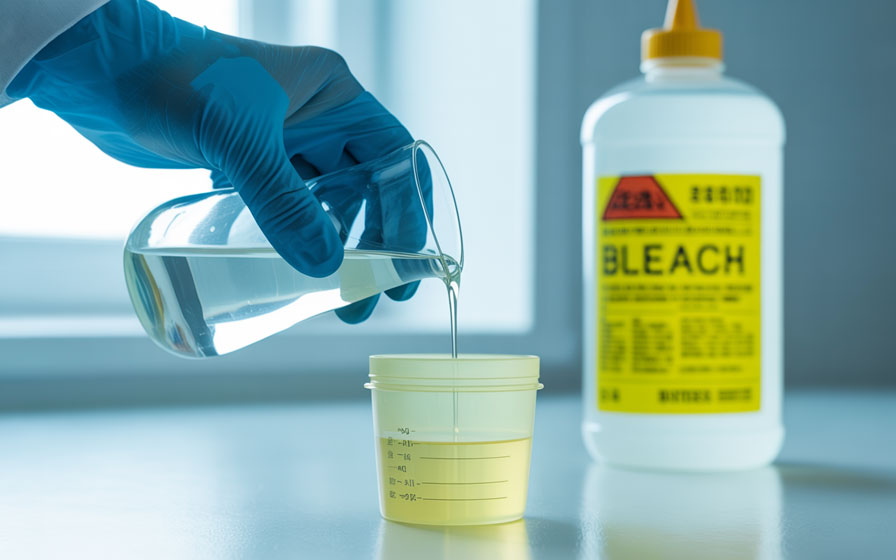
Urine Urine Testing in the U.S.: Integrity Checks, Not Just Screens
Urine testing in the U.S., especially in workplace or forensic settings, is governed by the U.S. Department of Health and Human Services (HHS) Mandatory Guidelines. Under those guidelines, labs must not only screen the urine (immunoassay or equivalent) but also perform Specimen Validity Testing (SVT) on every urine specimen. SVT includes checks for:- Creatinine
- Specific gravity
- pH
- Oxidant / adulterant presence
This requirement ensures that labs detect adulteration (substance added after collection) or substitution (fake urine) rather than simply trusting that the sample reflects what the donor passed.
Because oxidising adulterants (like bleach) are explicitly anticipated, laboratories routinely include oxidant assays or employ adulteration-detection strips that detect bleach, nitrite, chromate, or other compounds.
U.S. regulatory and methodological backing
The Mandatory Guidelines for Federal Workplace Pee Testing Programs require that “one or more specimen validity tests for oxidizing adulterants … be performed on every specimen.�
(See HHS federal register documentation.)
Many laboratories in the U.S. adopt CEDIA Sample Check assays or similar strategies to flag samples containing interfering compounds (including bleach). For example, one clinical report describes how the Sample Check assay and oxidant assay were used to detect adulteration in urine specimens, including detecting bleach. > clinmedjournals.org
A 2024 review of workplace urine testing methods notes that adulteration (especially via oxidants) remains one of the primary challenges and that advanced detection of sample manipulation is a growing focus in U.S. laboratories. ScienceDirect
What does this mean for bleach use in a pee sample?
Because U.S. labs are built to expect and detect adulteration, adding bleach is essentially a red flag, not a backdoor route to a clean result.Chemistry: What Bleach Does to a Urine Sample (and Why That Backfires)
Bleach (typically sodium hypochlorite, NaOCl) is a strong oxidant. In vitro (i.e. added to a collected urine sample), it can:- Oxidise or degrade certain metabolites and genetic traces in urine, reducing measured concentrations
- Alter pH dramatically (bleach solutions are strongly alkaline)
- Interfere with immunoassay chemistry, e.g. via oxidising reaction substrates or cofactors
- Leave chemical residues or oxidation by-products detectable by labs
However, these “effects� are not stealthy. When bleach is present at meaningful strength, it triggers sample validity flags.
Evidence from experimental studies
In the study “Urine adulteration: can bleach be used to mask MDMA use?�, Pham et al. (2013) demonstrated that at high concentration, sodium hypochlorite added to urine could produce false-negative readings in CEDIA immunoassays for MDMA. But those false negatives were accompanied by strong negative signals (e.g. “−0.85� reading) which are themselves anomalous and prompt further investigation. Moreover, confirmatory GC-MS performed afterward still measured reduced but detectable concentrations in many cases. RSC Publishing
A broader review, discussed in ScienceDirect, discusses how numerous household chemicals (including bleach) have been tested in vitro and how modern laboratories counter them via validity tests.
PMC notes that many adulterants (though not all) are detected by integrity assays; bleach is explicitly flagged by some commercial adulteration strips.
In clinical practice, labs suspect adulteration if pH < 3 or > 11, or specific gravity outside normal bounds, or anomalous creatinine — limits commonly cited in U.S. toxicology and clinical test-interpretation literature. (E.g. see Clinical Interpretation of Urine Drug Tests, Moeller et al.)
Mayo Clinic Proceedings
Thus, rather than quietly neutralising detection, bleach tends to generate invalid or tampered flags — which means the test is rejected or a re-collection is demanded.
What Happens When a Lab Flags Bleach or Adulteration?
Once SVT or adulteration screening raises suspicion (e.g. high oxidant levels, abnormal pH or SG), standard procedures include:
- Reporting the specimen as “Adulterated� or “Invalid� rather than “Negative.�
- Requiring a retest (often under direct observation).
- Triggering disciplinary, legal or administrative consequences, depending on policy and context.
- In forensic, employment or regulatory settings, the adulteration itself is often treated as misconduct or test evasion, sometimes more severely than a positive result.
Because adding bleach is more likely to result in an invalid test than a clean “negative,� it is both scientifically ineffective and procedurally risky.
Why Drinking Bleach Is a Dangerous, Fruitless Idea
Beyond the testing logic, there is a medical emergency inherent in ingesting bleach or similar oxidants. Drinking bleach does not detoxify your urine or reset your body chemistry in any beneficial way - it only poses serious harm.Why is bleach toxic?
Bleach (sodium hypochlorite) is caustic: it causes liquefactive necrosis (dissolving of tissue) when in contact with mucous membranes.
The strong alkalinity of bleach damages cells, proteins and lipids in the gastrointestinal tract.
Oxidative stress and chemical injury can cause systemic complications (metabolic derangements, burns, shock) if large amounts are absorbed.
These mechanisms are documented in the toxicologic literature. For example:
A review “The clinical toxicology of sodium hypochlorite� (Slaughter et al., 2019) summarises epidemiology, mechanisms and clinical features of hypochlorite poisoning.
Ingestion of bleach may produce corrosive injury to the mouth, throat, oesophagus, stomach — burning, ulceration, perforation in severe cases.
Taylor & Francis Online
Symptoms often include pain, drooling, difficulty swallowing (dysphagia), vomiting, abdominal pain, possibly bleeding.
Medscape
In rare or large ingestions, systemic effects like metabolic acidosis, hypernatremia / hyperchloremia, shock, and respiratory complications (due to aspiration or inhaled vapour) have been reported.
Taylor & Francis Online
A case report of intentional ingestion of household bleach describes severe mucosal injury in an elderly patient.
PMC
Another case: a 65-year-old man swallowed a bleach tablet (3.5 g), then developed aphonia (voice loss) and airway injury.
BMJ Case Reports
Medical guidelines for caustic ingestion emphasise urgent assessment, airway protection, avoidance of induced vomiting or neutralising agents, and consideration of endoscopy to assess damage.
Medscape
Mount Sinai’s health library notes that ingestion of bleach (even diluted) can produce burns and should be treated as poisoning.
Mount Sinai Health System
Similarly, UK governmental toxicology references acknowledge that ingesting sodium hypochlorite can cause mouth/throat burns, gastrointestinal irritation, diarrhoea, and in more severe cases, respiratory or systemic complications.
GOV.UK
Why bleach won’t help you pass a test
Bleach ingested enters your stomach and gut - it is not filtered selectively by your kidneys to “cleanse� urine.Metabolites are processed by the liver, then excreted via kidneys. Damage to GI lining doesn’t accelerate or eliminate those metabolites.
Moreover, ingesting bleach does nothing to counteract testing integrity checks (creatinine levels, pH, oxidant tests) - you may harm yourself but still be flagged.
The body cannot selectively degrade only genetic traces in urine or metabolites with bleach; the chemical would cause massive collateral damage to tissues.
So, ingesting bleach is medically harmful and in practice totally useless for tests.
Last update: 29.10.2025

